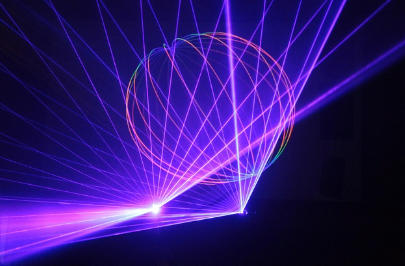
Although concert laser projectors create stunning visual effects, safety always comes first. Direct exposure to high-power lasers can cause permanent retinal damage within just a few milliseconds. For this reason, laser systems at all formal concerts must undergo strict safety calculations and area control.
The core concept is NOHD (Nominal Ocular Hazard Distance). Laser projection engineers calculate the distance within which the laser beam poses a potential hazard to human eyes, based on the laser’s power, divergence angle, and wavelength. Direct scanning of the audience is strictly prohibited within the NOHD.
How to ensure safety while maintaining visual impact? Three main strategies are used:
Beam ElevationThrough programming, the lowest point of all scanning graphics is set at least 2.5 to 3 meters above the audience’s heads. No matter how the beams move, their physical path always stays above the crowd.
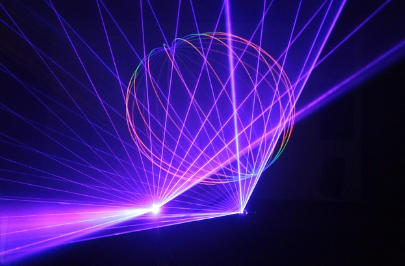
Scanning Angle RestrictionSoftware limits are configured on the control console to prevent the scanners from directing beams toward the audience. If an operator mistakenly attempts to aim light at the crowd, the system automatically blocks the command.
Dynamic Power AdjustmentWhen beams must pass close to or above the audience, the laser output power is automatically reduced to a safe level (e.g., below Class 3R). Full power is restored only when the beams are projected high into the sky or into the distance.
In addition, many countries (such as the U.S. FDA and EU IEC standards) require that large-scale laser shows be declared in advance and supervised on-site by a certified Laser Safety Officer (LSO). These strict safeguards protect the eye safety of hundreds of millions of audience members as they enjoy the visual spectacle.